
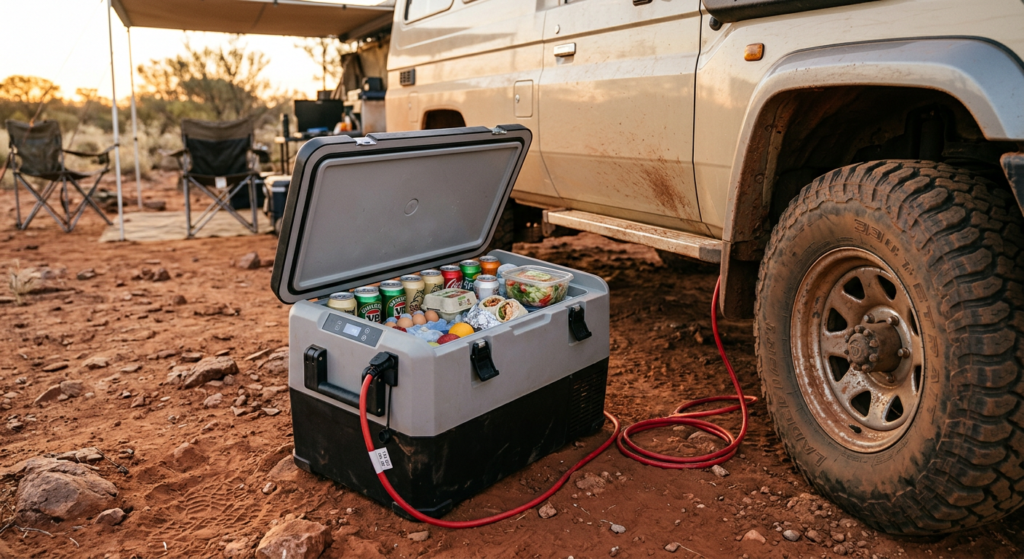
Do You Actually Need a Compressor Fridge?
A good overlanding fridge is one of the best upgrades you can make to a rig. It means cold drinks on a hot trail, real food instead of canned stuff, and the ability to carry medications that need refrigeration. But the market is full of options across a massive price range — and the difference between a $200 cooler with a Peltier chip and a $900 compressor fridge matters a lot more than most people realise before they buy.
This guide cuts through the marketing noise. We compare the main fridge types, explain what actually matters in the specs, and recommend the best options at each price point — with the honest cons included, because a fridge that fails 200 miles from the nearest town is a serious problem.
Fridge Types Explained: Compressor vs Thermoelectric vs 3-Way
Compressor Fridges (The Right Choice for Most Overlanders)
Compressor fridges use a 12V-powered vapour compression cycle — the same technology as your home refrigerator, just miniaturised. They maintain temperature regardless of ambient temperature, can freeze food if needed, and are highly efficient relative to their cooling capacity.
Pros: Efficient, reliable, works in extreme heat, can reach 0°C or below, maintains temperature when ambient temps are high.
Cons: Higher upfront cost ($500–$1200+), heavier than thermoelectric units, compressor can fail if not maintained, draws 3–10A average depending on conditions.
Thermoelectric / Peltier Coolers (Budget Option with Serious Limits)
Thermoelectric coolers use a Peltier chip to move heat from one side to the other. They’re cheap, lightweight, and have no moving parts. The problem: they can only cool to approximately 20–25°C below ambient temperature. If it’s 35°C outside, the best a Peltier cooler can do is around 10–15°C — which is not actually cold enough to safely store meat or dairy.
Pros: Cheap ($80–$250), lightweight, no compressor to fail, can also heat.
Cons: Cannot get cold enough in hot climates, high power draw relative to cooling, not suitable for food safety in summer, very short lifespan compared to compressor units.
Verdict: Fine for drinks in mild weather. Not suitable as a primary overlanding fridge if you’ll be in summer conditions or need to store food safely.
3-Way Absorption Fridges (RV Use Only)
3-way fridges run on 12V, 240V, or LP gas. They’re common in caravans and motorhomes but have no place in a truck or 4WD build. They must be level to operate, are extremely inefficient on 12V, and are far too slow to cool down. Ignore these for vehicle builds entirely.
What to Look for in a 12V Compressor Fridge
Compressor Type: SECOP / Danfoss vs Generic
The compressor is the heart of the fridge. The gold standard is the SECOP (formerly Danfoss) BD35F or BD50F compressor — used by ARB, Dometic, Engel, and National Luna. It’s proven over decades of overlanding use, runs quietly, and handles vibration well. Generic compressors found in cheaper units may work fine for years or fail in months — there’s no easy way to tell before you buy.
If a fridge doesn’t specify what compressor it uses, that’s a red flag. Reputable brands always advertise their SECOP or equivalent compressor as a selling point.
Power Consumption
Look at average daily consumption in watt-hours (Wh) rather than peak draw in amps. A 40L fridge should consume roughly 30–45Wh per day in mild conditions (around 25°C ambient). In summer heat (35°C+), expect 60–80Wh/day. This directly affects how large a battery you need — budget roughly 100Ah of usable AGM capacity or 50Ah of LiFePO4 per day of fridge use before you need to recharge. This is why a proper dual battery setup and correctly sized wiring are essential before choosing a fridge.
Volume and Form Factor
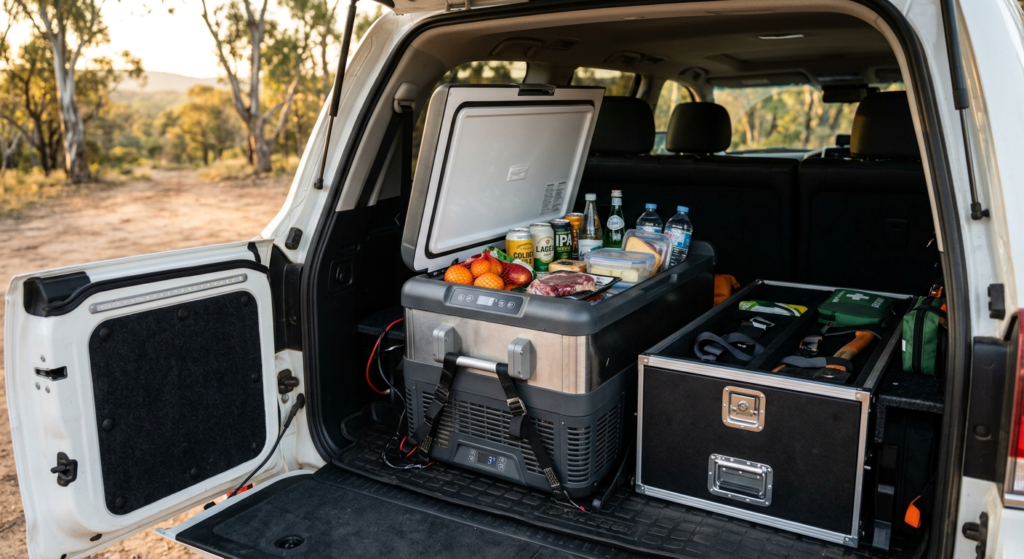
Most overlanders land on 40–60L as the sweet spot for a solo or couple setup. Bigger fridges are obviously more useful but draw more power, weigh more, and take up more cargo space. Measure your cargo area carefully before buying — many people size up too aggressively and then struggle with install or payload.
Top-opening vs slide-opening matters too. Top-opening (like the classic Engel) is more efficient because cold air doesn’t fall out when you open it. Slide or swing-door designs are easier to access in tight spaces.
Temperature Range
Any quality compressor fridge should reach 0°C or below. Freezer-capable units (typically -18°C) let you carry frozen meat on multi-week trips. If you only need refrigeration, a standard compressor fridge is more efficient. If you want to freeze, look for dual-zone models or dedicated freezer units.
Best 12V Fridges for Overlanding: Our Top Picks
Best Overall: ARB Zero 63L Fridge Freezer
The ARB Zero uses a SECOP compressor, features dual-zone capability (fridge + freezer simultaneously), runs on 12V/24V/240V, and comes with a quality lid organiser. It’s rugged, well-supported, and ARB’s network makes warranty service straightforward. The app connectivity for temperature monitoring is a genuine convenience feature, not a gimmick.
Pros: Rock-solid reliability, dual zone, ARB warranty and service network, efficient compressor, handles rough terrain well.
Cons: Premium price, heavier than some competitors, lid hinge could be more robust on older models.
Best for: Serious overlanders who want a fridge that will outlast the vehicle.
Best Value: BougeRV Fort 45L Fridge
BougeRV has disrupted the budget end of the market with a unit that punches well above its price. The Fort 45L uses a SECOP compressor (a genuine surprise at this price point), reaches -20°C, and comes with solid build quality. It’s not as refined as ARB or Dometic, but the core refrigeration technology is the same.
Pros: SECOP compressor at a budget price, reaches freezer temps, decent insulation, USB charging port built in.
Cons: Warranty and long-term support less proven than established brands, plastic latches feel less durable, app is basic.
Best for: Overlanders on a budget who don’t want to compromise on compressor quality.
Best for Tight Spaces: Dometic CFX3 35L
The Dometic CFX3 series is compact, extremely well-built, and one of the most efficient fridges on the market. The 35L size fits behind a rear seat or in tight cargo areas where a larger fridge won’t go. Dometic’s app connectivity and temperature control are the best in class. The CFX3 compressor is Dometic’s own variable-speed unit — highly efficient and quiet.
Pros: Compact footprint, premium build quality, excellent app, very efficient, handles vibration extremely well.
Cons: Expensive for the volume, 35L fills up fast for two people on a week-long trip, lid design traps water in the hinge area.
Best for: Solo travellers or couples with limited cargo space who want a premium, compact unit.
Most Durable: Engel MT45F-U1
Engel has been building compressor fridges since the 1960s. The MT45 uses Engel’s own swing-motor compressor — not a piston or rotary unit — which handles vibration and angle changes better than anything else on the market. Overlanders run these in expedition vehicles across the Sahara and the Simpson Desert. They are not the cheapest or the most feature-rich, but they are the most bulletproof.
Pros: Legendary reliability, swing-motor compressor handles extreme vibration and tilt, decades-long track record, can operate at significant angles.
Cons: Less efficient than SECOP-based units, no app connectivity, basic design with no fancy features, heavier than modern competitors.
Best for: Expedition-level overlanders doing remote travel where reliability is the only thing that matters.
Fridge Comparison Table
| Fridge | Volume | Compressor | Avg Draw | Min Temp | Best For | Link |
|---|---|---|---|---|---|---|
| ARB Zero 63L | 63L | SECOP | ~1.5A avg | -22°C | Best overall | Check Price → |
| BougeRV Fort 45L | 45L | SECOP | ~1.3A avg | -20°C | Best value | Check Price → |
| Dometic CFX3 35L | 35L | Dometic Variable | ~0.9A avg | -22°C | Tight spaces | Check Price → |
| Engel MT45F | 45L | Engel Swing-Motor | ~2.0A avg | -18°C | Max durability | Check Price → |
Affiliate disclosure: Links above are Amazon affiliate links. If you buy through them, we earn a small commission at no extra cost to you. We only recommend gear we’d actually run in our own rigs.
How to Wire Your Fridge Correctly
A fridge is only as good as the power system behind it. A few non-negotiable rules:
- Hard-wire it — don’t use the cigarette lighter socket. Cigarette lighter circuits are typically fused at 10–20A and use undersized wire. Hard-wire directly to your aux battery with a proper inline fuse.
- Use 10 AWG wire for runs up to 5 metres. A compressor fridge peaks at 8–12A at startup. Undersized wire causes voltage drop which makes the compressor work harder and shortens its life. See our complete wire sizing guide for the full chart.
- Wire to the aux battery, not the starter battery. A fridge running overnight will flatten a starter battery. Your dual battery system with a DC-DC charger is what makes overnight fridge use safe.
- Set the low-voltage cutoff. Most quality fridges have a built-in low-voltage disconnect. Set it to 11.8–12.0V for AGM, 12.0–12.2V for LiFePO4 to protect your battery from deep discharge.
Final Thoughts
If you’re serious about overlanding, a compressor fridge with a SECOP or equivalent compressor is the only real option. The BougeRV Fort gives you that technology at an accessible price. The ARB Zero gives you the full package with dealer support. The Engel gives you bulletproof simplicity that will outlast everything else.
Whatever you choose, make sure your electrical system can support it. A fridge running from an undersized battery through undersized wire is both inefficient and potentially damaging. Get the dual battery setup right first, size your wiring correctly, and your fridge will run cold for years.